The Essays.
As with the 1897 Hospital Fund issue, a public competition was held supported by the wave of strong patriotic feeling for the cause - if not for the concept of the issue. The plan was to have two denominations and suggestions could be entered for one denomination or for both.
The first prize for each denomination was 5 guineas (£5/5/-) while the second prize for each denomination was 2 guineas (£2/2/-).
The attention of the community of (hopeful) stamp designers was attracted and 120 entries were received. All entries were submitted under a nom-de-plume. The only judge of the competition entries was Mr. W. A. Watt, the Postmaster-General of Victoria.
The sole surviving essay of the 1900 competition is shown below.
It is titled "Victoria Cross" and was submitted by Sands & MacDougall.
There are annotations above and below the Essay by W.A.W. (Postmaster-General Watt).

R. L. Geneva, 27 November 1980. Lot 3311.
Rod Perry, David Feldman, December 1988, Lot 31179.
Prestige Philately, April 2006, Lot 421.
Dubois Collection, Corinphila, June 2024, Lot 40384.
The auction catalogue states the following:
"original stamp size handpainted artwork for a 2d Victoria Cross design in black & grey highlighted with China white affixed to a larger piece (60x92mm), the design with "Postage" added at sides, the card endorsed "2nd prize/(initials") at top & "1d One penny" at base. A spectacular essay of the highest significance.
- in all of Australian philately, this is one of only two post office stamp competition essay prizewinning designs in private hands;
- it is the only such Victorian essay available to collectors.;
- even more significantly, it is the only prizewinning design - Colonial or Commonwealth - to be adopted for an issued stamp;
On a wider stage, this is the only pre-WWII stamp of the entire British Empire to feature the Victoria Cross, the Empire's highest bravery award
.It is amazing that such a distinguished award for Military Honours is depicted on only the stamp printed from this Essay.
The Essay is therefore sought after by a variety of collectors representing a wide range of philatelic collecting interests.
The Proofs.
Proofs were taken from the steel dies engraved by Samuel Reading for both denominations. Only seven were printed - all on wove paper:
- for the 1d: in purple-brown (ex Purves) and in claret;
- for the 2d: in black, in orange (two), in brown-red and in green on pale green paper.
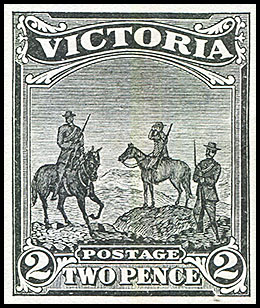
Has a wider border - about 4 mm left,
2 mm right and 3 mm top and bottom.
Provenance: Besacon (Corinphila Nov. 2018, Lot 3624).
Johnstone.
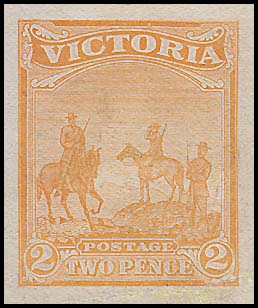
One of two known examples in this colour. Narrow border: One example (shown here) is trimmed to have a border of about 6 mm all around.
Provenance: Prestige Philately January 2004 Lot 615;
Prestige Philately August 2012 Lot 275.
Provenance: Russell Jones and Michael Silvasich;
Johnstone.
The other example has a wide border:
Provenance: Purves;
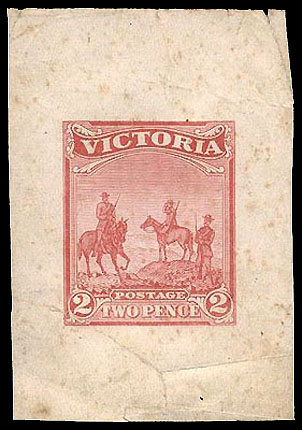
Only known example in this colour.
Prestige Philately January 2004 Lot 615. (Provenance: Russell Jones).
Prestige Philately August 2012 Lot 275 (Provenance:Michael Silvasich)
Johnstone.
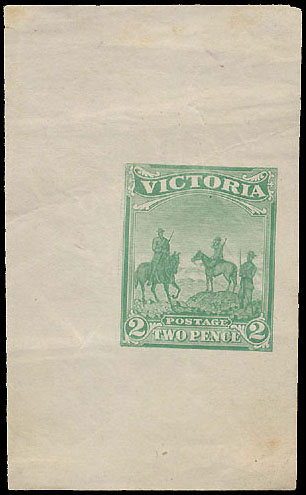
Only known example in this colour.
Provenance: Purves.
Rodney Perry April 1994 Lot 1258.
Millennium Auctions Rarities October 2006, Lot 668.